

Best Rat Traps on the Market
If you’ve noticed more mice and rats around lately, you’re not alone.
Some years seem much worse than others, and recently we’ve had rodents showing up in places where they’ve never been before. Many of our neighbors have been dealing with the same problem.
Weather patterns, food availability, and population cycles can all affect rodent activity. Wet summers and mild winters often allow mouse and rat populations to increase rapidly, leading to more unwanted visitors around homes, cabins, sheds, barns, and outbuildings.
For anyone living in rural areas or at an off-grid cabin, rodent control becomes especially important because mice and rats can damage wiring, insulation, food supplies, and equipment.
If you’re dealing with pests around your property, you may also find these guides helpful:
- How to Bear-Proof Your Cabin and Property
- Best Mosquito Control for Off-Grid Living
- Off-Grid Food Storage Solutions
Table of Contents
- Why Rodents Become a Problem
- Why I Avoid Rodent Poison
- The Best Rat and Mouse Traps I’ve Used
- Why This Trap Works So Well
- What Is the Best Bait for Rat Traps?
- Where to Place Rat Traps
- Additional Rodent Prevention Tips
- Pros and Cons
- Frequently Asked Questions
Why Rodents Become a Problem

Mice and rats are constantly searching for three things:
- Food
- Water
- Shelter
Cabins, garages, barns, sheds, chicken coops, and even vehicles can provide all three.
Once rodents move in, they can:
- Chew electrical wiring
- Damage insulation
- Contaminate food supplies
- Destroy stored equipment
- Spread disease through droppings and urine
The sooner you deal with an infestation, the easier it is to control.
If you’re storing bird seed, livestock feed, pet food, or emergency food supplies, keeping them in airtight rodent-proof storage containers can prevent many infestations before they start.
Why I Avoid Rodent Poison
Many people use poison to control rats and mice, but I generally avoid it.
Living in a rural area means there are plenty of animals that may eat a poisoned rodent, including:
- Owls
- Hawks
- Eagles
- Foxes
- Coyotes
- Domestic cats and dogs
Secondary poisoning can occur when predators consume poisoned rodents.
For that reason, I prefer using mechanical traps whenever possible.
One of the best long-term solutions is to stop rodents from entering in the first place. I keep a supply of steel wool for sealing small gaps and holes and use Great Stuff Pestblock expanding foam around larger openings.
The Best Rat and Mouse Traps I’ve Used

Over the years I’ve tried many different mouse and rat traps.
Some worked reasonably well.
Others barely worked at all.
The trap that has impressed me the most is the Tomcat Rat Trap. Despite the name, I’ve successfully used it for both rats and mice around our property.
What I like most is how easy it is to set compared to traditional wooden snap traps. It’s durable, reusable, and powerful enough to deal with larger rodents while still being sensitive enough to catch mice.
Why This Trap Works So Well
Unlike the old wooden snap traps many of us grew up using, the TomCat features:
- Easy one-handed setting
- Powerful spring action
- Durable construction
- Simple cleanup
- Large built-in bait cup
The bait cup is one of the reasons this trap works so well.
With older traps, rodents could sometimes steal peanut butter or other bait without setting off the trap. The Tom Cat uses a deep bait cup that forces the rodent to work harder to reach the bait, greatly increasing the chances of triggering the trap.
I’ve found it to be one of the most reliable rodent traps available, especially for cabins, sheds, garages, workshops, barns, and other rural properties.
Tom Cat Rat Trap
Great for:
- Homes
- Cabins
- Garages
- Workshops
- Barns
- Chicken coops
- Storage buildings
If you’re looking for a poison-free way to control mice and rats, this is the trap I recommend first. It’s easy to use, reusable, and highly effective for both small and large rodents.
For larger properties, barns, or workshops, I recommend setting multiple traps at the same time. A Tomcat Multi-Pack Bait Stations are often more economical than purchasing traps individually.
Rodent-Proof Food Storage Containers
A smart investment if you store animal feed, bird seed, or emergency food supplies.
Steel Wool and Expanding Foam
Perfect for sealing entry points around pipes, vents, and utility penetrations.
Motion-Activated Shop Lights
Rodents prefer dark hiding places. Improved lighting can help discourage activity in sheds and workshops.
What Is the Best Bait for Rat Traps?
Most people immediately reach for peanut butter.
Peanut butter certainly works and has been a popular bait for decades.
However, I’ve had excellent success using pumpkin seeds.
Simply place two or three pumpkin seeds inside the bait well.
Other effective baits include:
- Sunflower seeds
- Oats
- Nut pieces
- Bird seed
- Bacon
The key is using a small amount so the rodent must work to retrieve it.
Where to Place Rat Traps
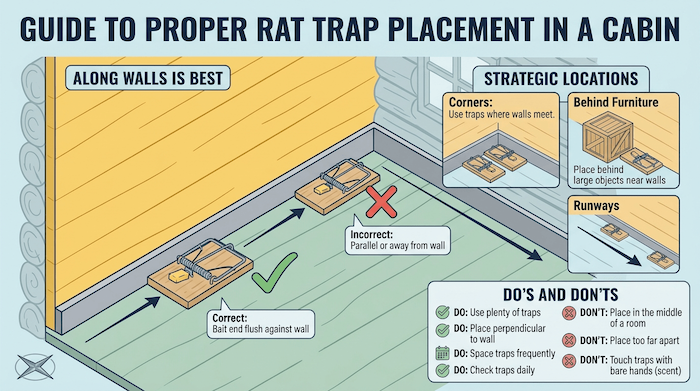
Placement is often more important than bait.
Rodents rarely travel through open spaces.
Instead, they move along:
- Walls
- Foundations
- Shelving
- Behind equipment
- Along fence lines
For best results:
- Place traps perpendicular to walls.
- Position the bait end against the wall.
- Set multiple traps in problem areas.
- Check traps daily.
- Continue trapping until activity stops.
Additional Rodent Prevention Tips
Even the best trap works better when combined with prevention.
Seal Entry Points
Mice can squeeze through holes as small as a dime.
Inspect:
- Foundation gaps
- Door openings
- Utility penetrations
- Roof vents
- Siding gaps
Remove Food Sources
Store:
- Pet food
- Livestock feed
- Bird seed
- Pantry supplies
inside sealed containers whenever possible.
Reduce Nesting Areas
Keep:
- Firewood stacks away from buildings
- Tall grass trimmed
- Junk piles cleaned up
- Storage areas organized
Pros and Cons
Pros
- Very effective
- Easy to set
- Easy to clean
- Durable construction
- Humane and quick
- No poison required
- Reasonably priced
Cons
- Requires manual checking
- May need multiple traps for heavy infestations
Overall, I honestly haven’t found many negatives. These are some of the most effective rodent traps I’ve used and have become my go-to recommendation for both mice and rats.
Frequently Asked Questions
What is the best bait for rat traps?
Peanut butter, pumpkin seeds, sunflower seeds, and small nut pieces all work well.
Are snap traps better than poison?
For many rural properties, yes. Snap traps avoid the risk of secondary poisoning to wildlife and pets.
How many traps should I use?
More than most people think. For active infestations, use multiple traps in several locations.
Can mice learn to avoid traps?
Some rodents become trap-shy, which is why changing bait types and trap placement can help.
How do I keep mice out of my cabin permanently?
The best approach combines trapping, sealing entry points, removing food sources, and maintaining a clean storage area.
Disclosure
This post may contain affiliate links, including Amazon affiliate links. If you purchase through these links, I may earn a small commission at no extra cost to you. The information shared on this website is based on personal experience and research and is intended for general informational purposes only. Always use proper safety precautions and follow manufacturer guidelines when using tools, equipment, or outdoor gear.
© 2019 – 2026, Teresa. All rights reserved.
Thanks for this info about the best rat and mice traps. I really hate rats. Mice are not so bad. Your article is really timely because we have just have a mouse. Or maybe more than one.
Is it true that it’s quite easy to catch a mouse, but it’s much harder to get rid of rats?
These traps are really great for both. I hate the old wooden ones, you have touch the animal to get them out where these ones you don’t, and they are much easier to clean and reuse. I used to just throw the old ones out mouse and all…..got pretty expensive at time.
Since I have moved to my new apartment, rats have been my greatest enemy and I couldn’t be more grateful for you to have shared this with me. I actually like the fact that you even specify the things I can use as my bait. This is simply awesome with me. Thank you so much for sharing this out with me. I will get the catch master 2snipper right away. Thumbs up on this
Hi Rodarrick,
There is nothing worse than dealing with rats, I can’t stand them. I’m sure you will like these traps.
Certainly does look like a better mouse trap to me. I’ve always used the wooden spring released mouse traps until recently. And I hate how the blood from the mouse gets caught in the wood base and the mess involved in getting the remains out.
The trap you reviewed looks far easier to use and clean. If a need for such a trap arises again, I will definitely be getting this brand. Right now we have 4 cats, so mice keep their distance from our little cabin in the woods. That’s my current solution to the problem. 🙂
Hi Fraser,
These traps are by far better than those old wooden ones. I really didn’t like using them at all. With 4 cats I’m sure you will be ok. We have one at home, but she just can’t keep up with them this year.
Hello Teresa, I must say that this article is very helpful and informative. I have mouses in my cellar and just like I don’t want to use poisons of any kind just because of safeness. I tried many traps but nothing worked so far, those critters are very intelligent. I will try your recommendation which is not expensive at all, I hope it will work.
I think you will like these traps, we have been trapping mice steady in them this year. I don’t like using poison either especially out off grid for fear other animals or pets will get into it or eat a dead mouse or rat that has been poisoned.
Hi Teresa
I always interested in people’s opinion on rat and mouse traps, as you can guarantee some time in your life you will deal with this problem. You can say that I have been blessed and have had to deal with both. I have tried both mouse and rat traps, with little success. The animal is question always seem to take the bait but not set the trap off. The only success I have especially with rats is poison, as this will control them. The problem is that rats are becoming cleverer and getting good at avoiding all sorts of traps. With super rats becoming more of a problem means that more sophisticated means are required. What are we to do?
Thanks for an interested review.
Antonio
Hi Antonio
We had always used peanut butter in the past, but I’m finding for some reason pumpkin seeds seem to attract them better. Also with bigger rats like the pack rats we get here, it is good to attach the trap to something as they can some times take off trap and all. thanks for stopping by the site and commenting