
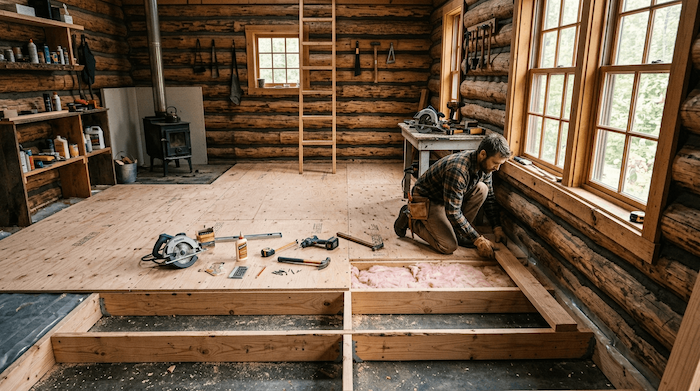
The Cabin Floor
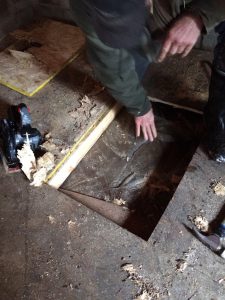
One of the first major projects we tackled in our little cabin was replacing the floor.
The old floor had seen much better days. It was dirty, damaged, and clearly needed to go. We were almost certain that once we removed the old flooring we’d discover nothing but a dirt floor underneath.
Removing the Old Cabin Floor
Whoever had built the cabin originally had constructed a raised wooden floor over the concrete slab and then covered it with particle board.
Once we started removing the old flooring, we could finally see what we were working with and begin planning the new floor installation.
Discovering the Concrete Floor
After removing the entire floor, we found something unexpected.
There was a drain located right in the middle of the cabin floor, and the concrete sloped toward it from all directions.
To this day, we’re still not completely sure why there was a drain in such a small cabin. It may have been used for washing equipment, storing animals at one time, or perhaps the building served a different purpose before becoming a cabin.
Regardless of its original purpose, the sloped floor meant we would need to build a raised floor system again and level everything before installing the new floor.
The plywood for the new floor would actually be salvaged from the old cabin addition that we planned to remove, helping us save both money and materials.
Preparing the Floor
Before any framing could begin, we needed to clean up the concrete slab and gather materials.
We brought additional rigid foam insulation from the main cabin and salvaged plywood from the addition.
Normally, many builders would place a polyethylene vapor barrier directly over the concrete. However, we had an abundance of rigid foam insulation available from our previous roof replacement project.
Rather than letting it go to waste, we decided to use the foam insulation as both a moisture barrier and insulation layer.
If you’re heating with wood like we do, you may also want to read Small Wood Stove for Tiny Cabins.
Cutting the insulation
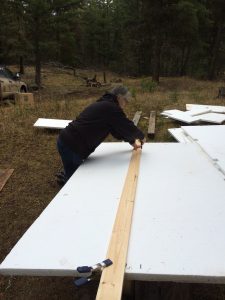
While Scott worked on leveling and framing the floor, my job was cutting the foam insulation to fit.
Each piece was measured and cut to fit tightly against the framing.
The foam insulation was placed directly on top of the concrete slab to help reduce moisture transfer and improve the cabin’s insulation value.
Framing the Floor
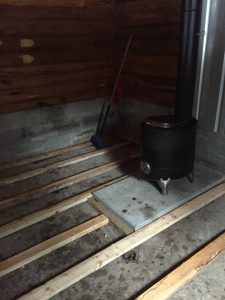
Once the insulation pieces were ready, Scott began building the floor frame.
Each board was cut to size before being positioned on the concrete.
To secure the framing, holes were drilled through the lumber and into the concrete slab.
A small piece of wire was inserted into each hole before driving the screws. This old trick helps the screws grip more securely in concrete when specialized anchors aren’t available.
The boards were fastened approximately every foot, creating a solid foundation for the new floor.
Installing insulation and plywood floor
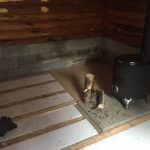
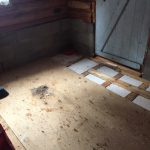
After the floor framing was secured, the foam insulation was installed between each floor joist.
Next came the plywood subfloor.
The plywood sheets were cut to fit and laid over the framing and insulation.
Once positioned, the plywood was screwed securely to the floor framing.
This part became my job.
I installed screws roughly every eight inches across the entire floor.
Trust me—that plywood isn’t going anywhere!
The Cabin Starts Feeling Like Home
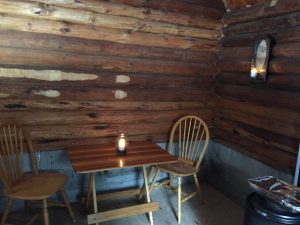
The next time we visited the cabin, I brought a folding table, a couple of chairs, and some candles.
For the first time, it felt like we actually had a place to sit, relax, and enjoy our little off-grid retreat.
It’s amazing how one project can completely change the feel of a building.
With the floor finally complete, we were ready to move on to the next project: planing and finishing the cabin walls
Lessons Learned From Installing a Floor Over Concrete
Looking back, there are a few things we learned from this project:
- Salvaged materials can save a lot of money.
- Foam insulation helps reduce moisture transfer from concrete.
- Taking time to level the floor properly makes every future project easier.
- A solid floor instantly improves the comfort of a cabin.
- Even small improvements can make an unfinished cabin feel like home.
If you’re planning your own cabin build, you may also find these helpful:
Recommended Tools
- Hammer Drill for Drilling Concrete
- Rigid Foam Insulation Panels
- Construction Screws for Wood Framing
- Circular Saw for Cutting Plywood
- Cordless Drill and Driver Set
- Moisture Meter for Checking Concrete Floors
- Tape Measure and Carpenter’s Square
- Knee Pads for Flooring Projects
Disclosure
This post may contain affiliate links, including Amazon affiliate links. If you purchase through these links, I may earn a small commission at no extra cost to you. The information shared on this website is based on personal experience and research and is intended for general informational purposes only. Always use proper safety precautions and follow manufacturer guidelines when using tools, equipment, or outdoor gear.
© 2017 – 2026, Teresa. All rights reserved.
Greetings,
I wonder if would be better off in having the same material for both roofing and flooring due to vapor barrier and insulation purposes. Is there any relation to weather? Furthermore, it depends on the room, isn’t it? Like shower rooms and kitchens would need foam insulation but not bedrooms? May I know your personal opinion?
We used the foam insulation because if was available. Normally on a roof you would put a vapour barrier of poly and then put bale insulation on top of that. We did the foam because we had it an then the bale insulation on top. It will no doubt give it a better R value. Same with the floor, it will probably help keep it warmer, which is good. We used it because that is what we had available. For inside walls you do not need to insulate, although in the house we just built we put insulation between the kitchen and laundry room to cut down on the noise of the washing machine.