
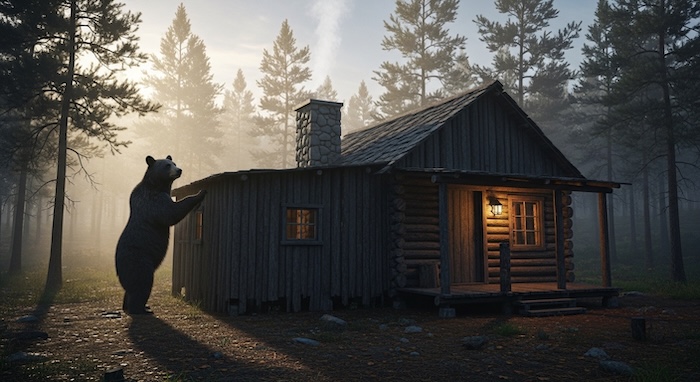
Living off-grid comes with incredible rewards—peace, quiet, and a deep connection to nature. But it also means sharing your space with wildlife.
At our property, bear encounters aren’t rare. In fact, over the past few summers, I’ve seen a bear almost every time I’ve driven up to the cabin.
And let me tell you—those moments will wake you up fast.
My First Bear Encounter at the Cabin
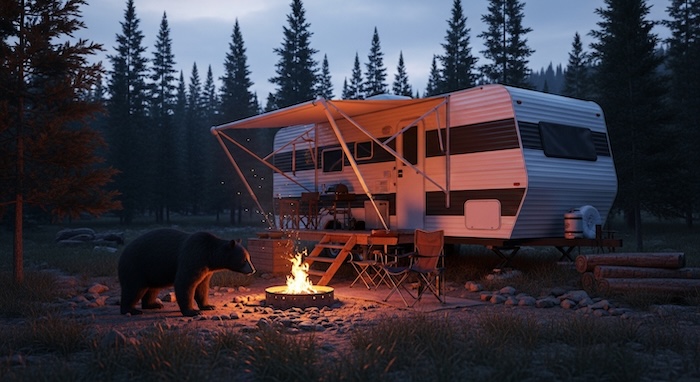
One summer evening, after a long day of work, Scott and I were relaxing by the fire beside our travel trailer.
We had a rifle leaning against the trailer about 40 feet away—something we kept nearby for peace of mind.
Out of the corner of my eye, I saw movement.
Quietly, I said, “Bear.”
A black bear had wandered right into camp, completely unaware of us—and stopped beside the rifle.
Scott jumped up and yelled,
“Outta here, bear!”
Twice.
I grabbed my phone, hoping to snap a photo, but that bear took off so fast it vanished into the trees.
That moment taught me something important: Bears are curious and bold—but they don’t like sudden noise.
Signs of Bears Around the Property
After that encounter, we started noticing more signs.
- Large piles of scat near the cabin door
- Tracks in the dirt and soft ground
- Disturbed logs and brush
Scott joked,
“If you’re going to have pets, you need to clean up after them.”
But the truth is—those signs matter.
If you’re setting up a remote property, you should also read → Bear Proofing the Chicken Coop or Safety & Wildlife
Because once bears find a food source, they come back.
Do “Urine Fences” Really Keep Bears Away?
I’ve heard this one more than a few times—mark your territory and bears will stay away.
So I looked into it.
Here’s what I found:
- Urine carries scent—and bears are curious
- Salt content may actually attract them
- Some suggest marking higher on trees
- Inupiaq Eskimos reportedly used this method
- Others rely on scent + noise deterrents instead
👉 Bottom line?
There’s no solid proof this works consistently.
It might help—but it’s not something I’d ever rely on.
Bear Safety Tips for Off-Grid Living
Living with wildlife means being prepared—not paranoid.
Here’s what’s worked for us:
1. Watch for Warning Signs
Look for:
- Scat
- Claw marks
- Tracks
- Torn-up logs
2. Understand Bear Behavior
Bears are most active:
- Spring (coming out of hibernation)
- Summer (feeding heavily)
- Fall (bulking up before winter)
3. Control Every Scent
A bear’s sense of smell is incredibly powerful.
That means:
- Food
- Garbage
- Soap
- Lotion
- Even toothpaste
All of it can attract them.
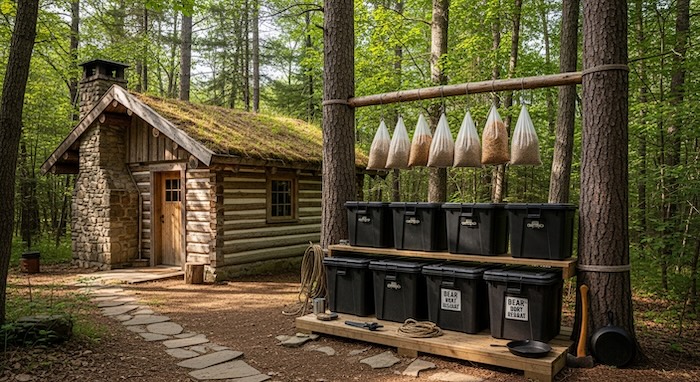
Use airtight storage like bear-resistant food containers or heavy-duty sealed bins
4. Store Food Properly
- Never leave food outside
- Keep garbage sealed
- Store everything away from sleeping areas
For full off-grid food storage strategies → Long-Term Food Storage Guide
5. Use Noise as a Deterrent
Bears don’t like surprises.
Simple things help:
- Talking loudly
- Clapping
- Wind chimes near your cabin
💡 Amazon placement:
Solar-powered motion alarms or tripwire alarms can alert you early
One simple thing I’ve started using when walking around the property is bear bells. They create a constant noise as you move, which helps avoid surprising a bear at close range—something that’s often the cause of an encounter.
6. Carry a Reliable Deterrent
This is one thing I don’t skip anymore.
Bear spray is one of the most effective non-lethal deterrents available
Keep it accessible—not buried in your pack.
In addition to bear spray, some people also carry bear bangers. These are small noise deterrents that fire off a loud crack to scare a bear away from a distance—giving you a chance to avoid a closer encounter altogether.
I see these used a lot in more remote areas, especially where visibility is limited or bears are more active.
Final Thoughts
Living off-grid means sharing the land with wildlife—and black bears are part of that reality.
Some methods might help. Others are more myth than fact.
But the most important things are always the same:
- Awareness
- Preparation
- Respect
Every encounter is a reminder:
👉 This is their home too.
If you stay alert and take simple precautions, you can safely enjoy everything off-grid living has to offer—without unwanted surprises.
Disclosure: This content is for informational purposes only and reflects personal experience. Always evaluate safety and security solutions for your specific location. Some links may be affiliate links.
Updated March 2026
© 2016 – 2026, Teresa. All rights reserved.
First of all, should I say, “Holy Bear Poop!” I would have been terrified to have a bear that close. I even grew up in bear country and never encountered a bear so close.
Your article is well-written with some great tips on how to be safe while moving around and living in areas where there are bears. I had never heard about the “urine fence” for a bear, but have seen a documentary about it for a wolf pack.
That was my first encounter with a bear and I’m hoping not to have anymore. That’s interesting about the urine fence for a wolf pack as well (we have wolf and cougar in the area as well)