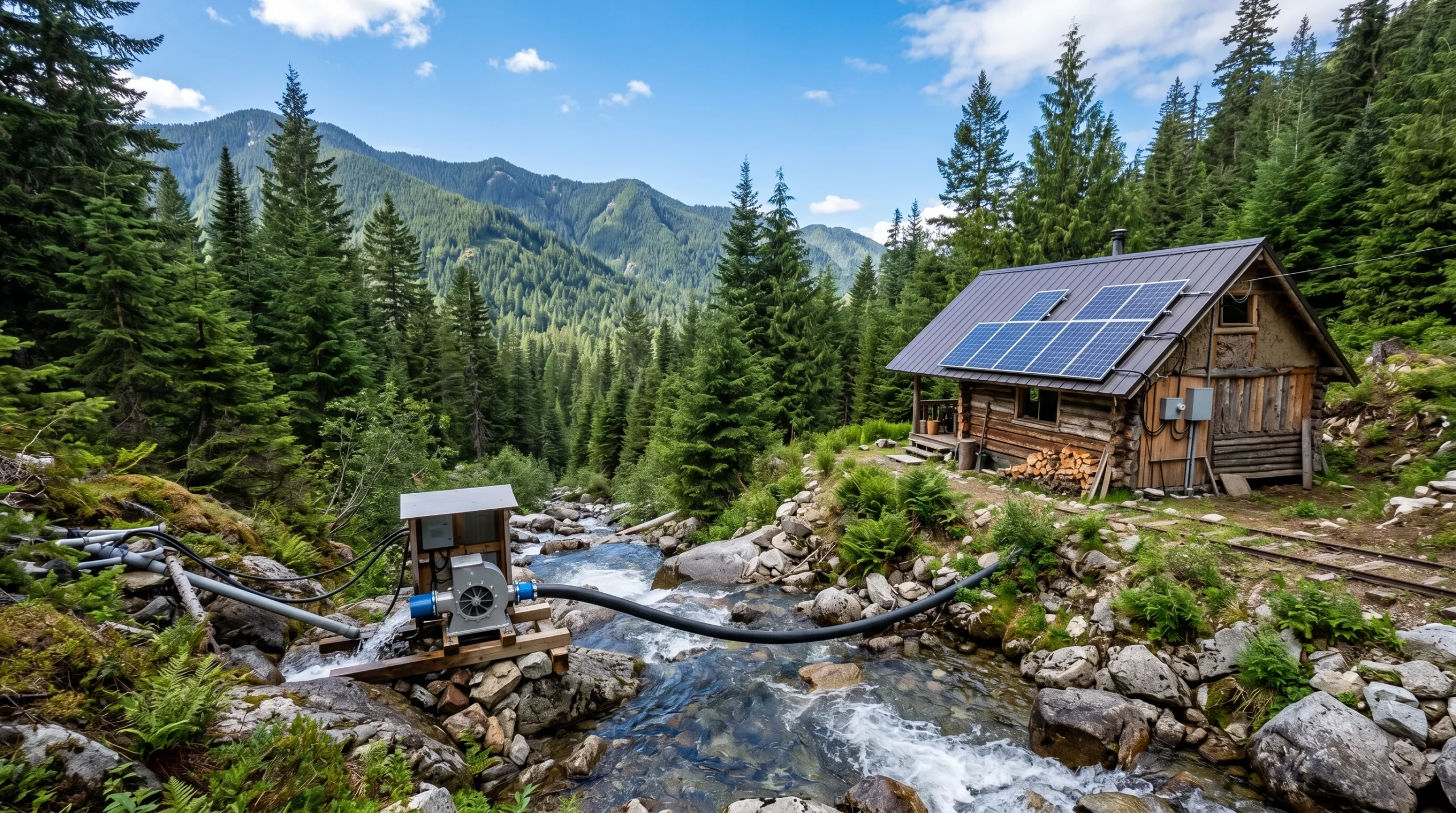
If you’re planning an off-grid cabin, homestead, or remote property, one of the biggest questions you’ll face is whether to invest in solar power or micro-hydro power.
I’ve used solar on our off-grid property for years, and I’ve spent a lot of time researching micro-hydro systems because many rural properties have streams, creeks, or seasonal water sources that could potentially generate electricity.
The truth is that both systems can work extremely well, but they solve different problems.
Solar power is available almost everywhere, while micro-hydro can produce electricity around the clock if you have the right water source.
In this guide, I’ll compare micro hydro vs solar, explain the pros and cons of each system, and help you decide which option makes the most sense for your property.
If you’re still exploring different energy sources, you may also want to read my Off-Grid Power Options: Complete Guide, where I compare solar, generators, micro-hydro, wind power, and battery systems for remote properties.
Micro Hydro vs Solar: Which Is Better?
There isn’t a single winner.
The best system depends entirely on your land.
If you have a year-round stream with sufficient flow and elevation drop, micro-hydro can produce more electricity than a much larger solar array.
If you don’t have reliable water, solar is usually the easiest and most practical choice.
Many experienced off-grid homeowners eventually discover that a combination of both systems provides the greatest reliability.
How Solar Power Works Off-Grid
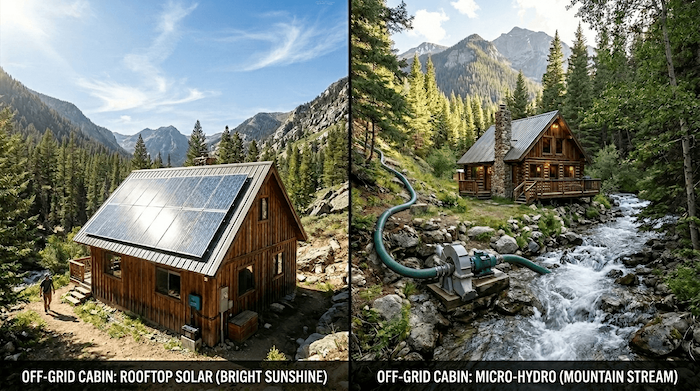
Solar panels convert sunlight into electricity.
That electricity flows through a charge controller and into a battery bank where it can be stored for later use.
A typical off-grid solar system includes:
- Solar panels
- MPPT charge controller
- Battery bank
- Inverter
- Monitoring system
Solar systems are popular because they:
- Have no moving parts
- Require little maintenance
- Scale easily
- Work almost anywhere
When building a solar system, I’ve found that investing in a quality MPPT charge controller is often worth the extra cost because it can harvest significantly more energy during cloudy days and winter conditions.
Many off-grid homeowners also upgrade to LiFePO4 batteries because they last longer, charge faster, and require less maintenance than traditional lead-acid batteries.
If you’re planning a solar setup, see my guides on Choosing Solar Panels for an Off-Grid Cabin and Solar Panels for a Cabin: What Size Do You Need?
A quality MPPT charge controller and LiFePO4 battery bank are two upgrades that can dramatically improve off-grid solar performance and long-term reliability.
How Micro-Hydro Power Works
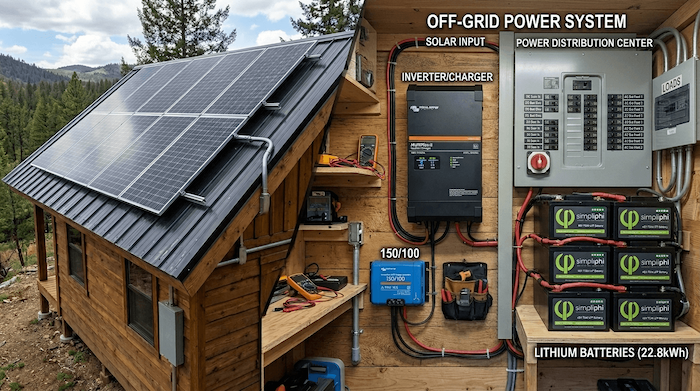
Micro-hydro systems generate electricity by moving water through a turbine.
Unlike solar, hydro power can operate 24 hours a day.
A typical micro-hydro system includes:
- Water intake
- Penstock pipe
- Turbine
- Controller
- Battery bank
- Inverter
The two factors that determine power output are flow and head.
Flow
The amount of water available.
Head
The vertical drop between the intake and turbine.
Even a modest stream can generate useful electricity if there is enough head.
Before purchasing a turbine, it’s a good idea to measure your available water accurately. A simple water flow meter can help estimate stream output and prevent costly sizing mistakes later on.
For a complete breakdown of turbine types, sizing, and installation considerations, read Micro-Hydro Turbines For Off-Grid Homes: A Complete Guide.
A water flow meter can help determine whether a stream has enough flow to justify a micro-hydro system before investing thousands of dollars in equipment.
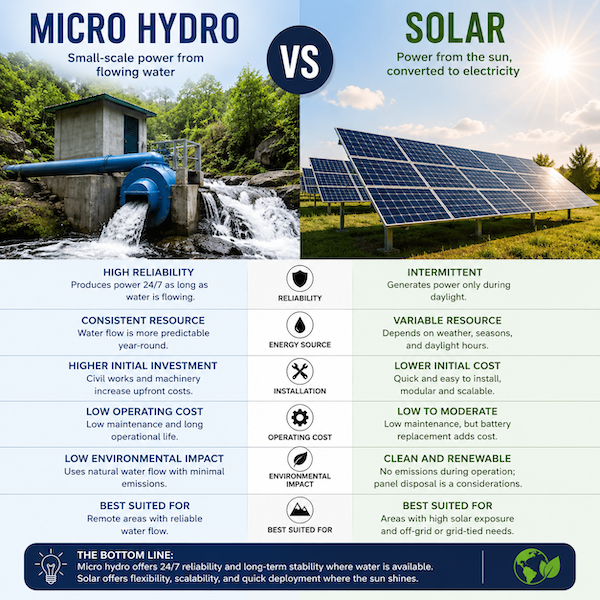
Power Output Comparison
| Feature | Solar | Micro-Hydro |
|---|---|---|
| Runs at night | No | Yes |
| Runs during storms | Limited | Usually |
| Seasonal variation | High | Moderate |
| Power consistency | Variable | Continuous |
| Energy production | Daylight only | 24/7 |
| Works almost anywhere | Yes | No |
One thing many people underestimate is how much energy a small hydro system can produce over time.
While a solar array only generates power during daylight hours, even a modest hydro turbine can run continuously.
That’s why properties with year-round streams often require smaller battery banks than solar-only systems.
A turbine producing only 200 watts continuously generates nearly 4.8 kWh per day.
Over a month, that’s enough electricity to surprise many off-grid homeowners.
Winter Performance
Winter is often the deciding factor.
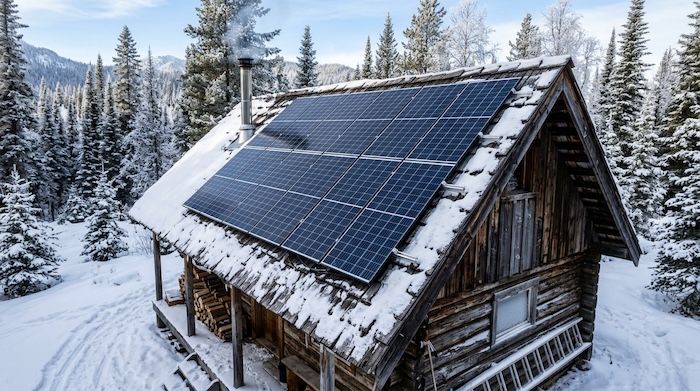
Solar output drops significantly due to:
- Shorter days
- Snow coverage
- Low sun angles
- Cloudy weather
Micro-hydro can continue generating power throughout winter if water flow remains available.
However, hydro systems can still face challenges including:
- Frozen intakes
- Ice buildup
- Debris accumulation
- Seasonal low-water conditions
If winter reliability is important, you’ll also want to read How to Prepare for Winter Off-Grid and Best Generators for Off-Grid Living.
Many off-grid homeowners keep a backup generator available for extended storms, maintenance, or emergencies.
 Cost Comparison
Solar Costs
Entry-level cabin systems can be relatively affordable and easy to expand over time.
Costs increase as you add:
- More panels
- Larger batteries
- Bigger inverters
Micro-Hydro Costs
Hydro systems often require:
- Site assessments
- Water intake construction
- Penstock installation
- Turbine equipment
Installation can be more labor-intensive than solar.
However, long-term energy production is often much higher.
Many cabin owners start with a small solar panel kit and expand over time as their power needs grow.
Maintenance Requirements
Solar Maintenance
Solar systems typically require:
- Cleaning panels
- Inspecting wiring
- Occasional battery maintenance
Hydro Maintenance
Hydro systems require:
- Cleaning intake screens
- Removing debris
- Checking penstocks
- Inspecting turbines
Hydro systems require more hands-on maintenance than solar.
A durable stainless steel intake screen is one of the most important components because it protects the turbine from sticks, leaves, and sediment that can reduce performance or cause damage.
A heavy-duty stainless steel intake screen is inexpensive insurance that can help extend turbine life and reduce maintenance.
When Solar Is the Better Choice
Solar is usually the best option when:
- You have good sun exposure
- No year-round stream exists
- You want simple installation
- You prefer low maintenance
- Budget is limited
Solar is also easier to install because most systems can be mounted near the cabin without requiring water diversions, pipelines, or permits.
If you’re considering a solar setup, my guides on Choosing Solar Panels for an Off-Grid Cabin and Solar Panels for a Cabin: What Size Do You Need? can help you avoid common sizing mistakes.
When Micro-Hydro Is the Better Choice
Micro-hydro is often superior when:
- You have a year-round creek
- Flow remains consistent through summer
- There is adequate head
- You want maximum power production
- Winter solar production is poor
For the right property, hydro can outperform solar by a wide margin.
Why Hybrid Systems Often Win
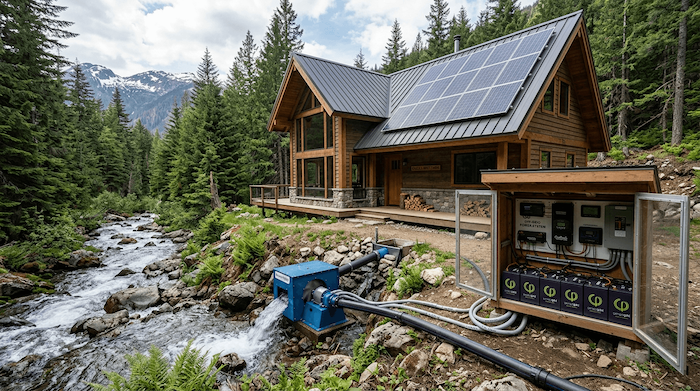
The best off-grid systems frequently combine both technologies.
Hydro provides continuous base power.
Solar increases production during sunny months.
Benefits include:
- Smaller battery banks
- Less generator use
- Better winter performance
- Greater system redundancy
One piece of equipment I recommend for almost every off-grid power setup is a portable watt meter.
Monitoring actual energy use makes it much easier to size batteries, solar panels, generators, and hydro systems correctly.
Many people are surprised to discover their largest power consumers are items they rarely think about, such as water pumps, refrigerators, and battery chargers.
A portable watt meter is one of the simplest tools for understanding how much electricity your cabin actually uses.
Final Verdict
If your property has a reliable year-round stream with sufficient flow and head, micro-hydro can be one of the most efficient off-grid power systems available.
If you don’t have flowing water, solar remains the simplest, most practical, and most common off-grid power solution.
For many properties, the real answer isn’t micro-hydro or solar.
It’s micro-hydro and solar working together.
A hybrid system can provide dependable power through changing seasons while reducing generator use and improving overall energy security.
The key is evaluating your site’s natural resources and building a system that takes advantage of what your land already provides.
Frequently Asked Questions
Does micro-hydro produce more power than solar?
Often yes. A small hydro system running continuously can generate more daily energy than a much larger solar array.
Can micro-hydro replace solar completely?
If water flow is reliable year-round, it can. Many off-grid properties operate primarily on hydro power.
How much water flow is needed for micro-hydro?
The answer depends on both flow and head. Even relatively small streams can generate useful electricity when enough vertical drop exists.
Is solar cheaper than micro-hydro?
Usually. Solar systems are generally easier to install and require less site-specific infrastructure.
What is the biggest advantage of micro-hydro?
Continuous 24-hour power production.
What is the biggest advantage of solar?
It can be installed almost anywhere with adequate sunlight.
Disclosure
This post may contain affiliate links, including Amazon affiliate links. If you purchase through these links, I may earn a small commission at no extra cost to you. The information shared on this website is based on personal experience and research and is intended for general informational purposes only. Always use proper safety precautions and follow manufacturer guidelines when using tools, equipment, or outdoor gear.
© 2026, Teresa. All rights reserved.