
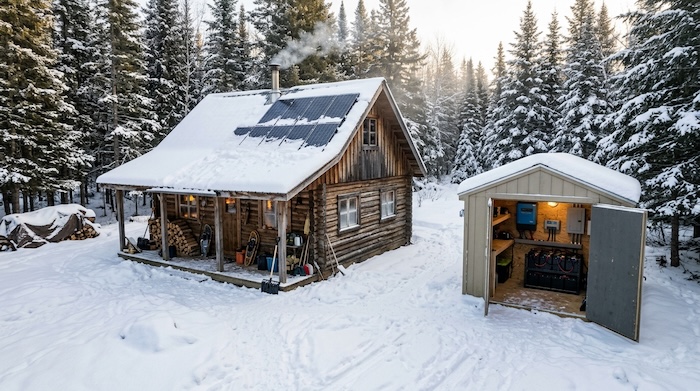
Choosing batteries for an off-grid cabin isn’t as simple as picking a popular brand or buying the biggest battery you can afford.
Before spending money, you need to know how much electricity your cabin uses, how many days you want to get through without sunshine, and how your batteries will perform when temperatures drop below freezing.
This is especially important in Canada, where short winter days, snow-covered solar panels, and freezing temperatures can make a battery bank that worked perfectly in summer struggle by January.
And there’s nothing quite like discovering your batteries are running low in the middle of winter, when getting to town for replacements isn’t exactly convenient.
The good news is that figuring out how many batteries you need for an off-grid cabin doesn’t have to be complicated.
In this guide, we’ll look at the different types of off-grid batteries, calculate how much battery storage you actually need, compare lithium and lead-acid batteries, and explain how to keep your system working through cold Canadian winters.
If you’re still planning your entire electrical setup, start with my guide to Off-Grid Power Systems: How to Choose What Actually Works for Your Site.
Table of Contents
- Why Getting Your Battery Bank Size Right Matters
- What Are the Different Types of Off-Grid Batteries?
- Lithium vs. Lead-Acid Batteries: Which Is Better?
- How Many Batteries Do You Need for an Off-Grid Cabin?
- Step 1: Calculate Your Daily Electricity Usage
- Step 2: Decide How Many Days of Battery Backup You Need
- Step 3: Account for Battery Depth of Discharge
- Step 4: Include Inverter Losses
- Step 5: Convert Battery Capacity Into Amp-Hours
- Off-Grid Battery Sizing Chart
- Weekend Cabin vs. Full-Time Off-Grid Home
- Do Off-Grid Batteries Work in Freezing Temperatures?
- How Much Extra Battery Capacity Do You Need for Winter?
- Can You Leave Batteries in an Unheated Cabin All Winter?
- How to Protect Your Off-Grid Batteries During Winter
- Should You Choose a 12V, 24V, or 48V Battery Bank?
- Why a Bigger Battery Bank Won’t Solve Every Winter Power Problem
- Do You Need a Backup Generator for Your Battery Bank?
- Common Battery-Sizing Mistakes to Avoid
- Battery Safety: A Few Things You Shouldn’t Overlook
- Frequently Asked Questions About Off-Grid Batteries
- Final Thoughts
Why Getting Your Battery Bank Size Right Matters
One of the biggest mistakes people make when planning an off-grid solar system is concentrating on solar panels while giving less thought to battery storage.
Solar panels produce electricity when sunlight is available. Your batteries store that energy so you can use it at night, during cloudy weather, and whenever your panels aren’t producing enough power.
A battery bank that’s too small can leave you constantly running a generator or worrying about whether you have enough electricity to get through the night.
On the other hand, buying more batteries than you actually need can be an expensive mistake.
The goal isn’t necessarily to build the biggest battery bank possible. It’s to build one that matches your lifestyle, electricity consumption, climate, and backup power options.
For a closer look at battery storage systems and available options, read my Best Battery Storage for Off-Grid Solar Systems guide.
What Are the Different Types of Off-Grid Batteries?
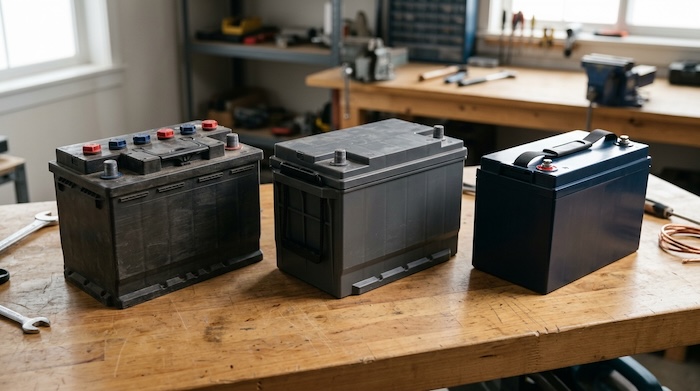
There are four main battery types commonly used for off-grid solar systems.
Each has advantages and disadvantages, and the best choice depends on how often you use your cabin, your budget, and where your batteries will be stored.
1. Flooded Lead-Acid Batteries
Flooded lead-acid batteries have been used in off-grid systems for decades.
They’re generally less expensive to purchase than lithium batteries, making them attractive when you’re trying to get a small solar system running on a limited budget.
However, they require regular maintenance, including checking electrolyte levels and adding distilled water when needed.
They also produce hydrogen gas during charging, which means they need appropriate ventilation and a properly designed battery enclosure.
Advantages:
- Lower initial purchase price
- Widely available
- Established technology
- Can work well in properly maintained systems
Disadvantages:
- Require regular maintenance
- Heavy and bulky
- Less usable capacity than lithium
- Shorter cycle life under comparable daily use
- Reduced capacity in freezing temperatures
- Flooded lead-acid batteries can still be a practical choice for someone who doesn’t mind maintenance and has a suitable location for the battery bank.
2. AGM Batteries
AGM stands for Absorbent Glass Mat.
These are sealed, valve-regulated lead-acid batteries that hold their electrolyte in fiberglass mats.
Unlike flooded batteries, they don’t normally require adding water.
AGM batteries are popular for smaller cabins, RVs, and backup power systems because they’re relatively straightforward to maintain.
Advantages:
- Low maintenance
- No routine watering
- Less expensive upfront than many lithium systems
- Suitable for occasional-use cabins
Disadvantages:
- Heavy
- Sensitive to repeated deep discharging
- Lower usable capacity than lithium
- Can be damaged by incorrect charging
- Still lose performance in cold weather
For a weekend cabin with modest electricity needs, AGM batteries may be worth considering.
If you’re comparing traditional battery options, you can check Renogy deep-cycle AGM batteries
3. Gel Batteries
Gel batteries are another type of sealed lead-acid battery.
Instead of having liquid electrolyte or electrolyte absorbed in fiberglass mats, they use a gelled electrolyte.
They require little maintenance but can be particularly sensitive to incorrect charging voltages.
Advantages:
- Low maintenance
- Sealed construction
- Can provide good deep-cycle performance when correctly charged
Disadvantages:
- Often more expensive than AGM
- Require compatible charging equipment
- Less commonly available for off-grid systems
- Performance varies considerably between models
Gel batteries can work well in specialized installations, but they wouldn’t automatically be my first choice for a new off-grid cabin system.
4. Lithium Iron Phosphate (LiFePO4) Batteries
Lithium iron phosphate batteries have become increasingly popular for off-grid solar storage.
You’ll often see them referred to as LiFePO4 or LFP batteries.
One of their biggest advantages is that you can generally use a much larger percentage of their rated capacity without shortening their lifespan as dramatically as you would with lead-acid batteries.
They’re also considerably lighter and typically provide many more charge-discharge cycles.
Advantages:
- High usable capacity
- Long cycle life
- Lightweight compared with lead-acid
- Little routine maintenance
- Good charging efficiency
- Well suited to regularly used off-grid systems
Disadvantages:
- Higher initial purchase cost
- Charging restrictions in freezing temperatures
- Require compatible charging equipment
- Battery management system limits must be respected
For a regularly occupied cabin or full-time off-grid home, LiFePO4 is often worth considering despite the higher upfront cost.
You can compare 12V 100Ah LiFePO4 batteries on Amazon to get an idea of available capacities and features.
For cold climates, pay particular attention to low-temperature charging protection and whether the battery includes an internal heater.
Lithium vs. Lead-Acid Batteries: Which Is Better?
Here’s a quick comparison of the four main battery types.
| Battery Type | Typical Usable Capacity for Planning | Maintenance | Main Consideration |
|---|---|---|---|
| Flooded lead-acid | 50% | Regular | Lower upfront cost |
| AGM | 50% | Low | Good for occasional use |
| Gel | 50% | Low | Requires careful charging |
| LiFePO4 | 80–90% | Very low | Long cycle life, cold charging limits |
These usable-capacity percentages are general planning assumptions. Always follow the manufacturer’s recommendations for your specific battery.
Battery Lifespan
Battery life is another important consideration.
A deep-cycle lead-acid battery might provide several hundred cycles at a specified depth of discharge, while a quality LiFePO4 battery may be rated for several thousand cycles.
Actual lifespan depends on the battery model, charging practices, temperature, and how deeply it is discharged.
A lithium battery that costs more initially may provide better long-term value if you’re using it every day.
However, for a cabin visited only occasionally, a less expensive AGM battery might make more financial sense.
Battery Weight
Weight is something people often overlook.
A traditional lead-acid battery bank can weigh several hundred pounds.
If you’re carrying batteries into a remote cabin, moving them through snow, or installing them in a small utility area, that extra weight matters.
LiFePO4 batteries generally provide much more usable energy for their weight.
How Many Batteries Do You Need for an Off-Grid Cabin?
This is where things get interesting.
There isn’t one battery-bank size that works for every cabin.
A small weekend cabin with a few LED lights and a phone charger will use considerably less electricity than a year-round home with a refrigerator, freezer, water pump, television, and other appliances.
To calculate the right battery-bank size, you need to know:
-
How much electricity you use each day
-
How many days of backup power you want
-
How much of your battery’s rated capacity you can use
-
How much energy is lost through your inverter and electrical system
-
How cold your batteries will get during winter
Let’s work through the calculations.
Step 1: Calculate Your Daily Electricity Usage
Start by making a list of everything you plan to run.
For each appliance, multiply its wattage by the number of hours it operates each day.
Watts × Hours Used = Watt-Hours
Here’s an example for a small cabin.
| Appliance | Power | Daily Operating Time | Daily Energy |
|---|---|---|---|
| LED lights | 40W | 5 hours | 200Wh |
| Small refrigerator | 60W | 8 hours | 480Wh |
| Water pump | 100W | 30 minutes | 50Wh |
| Laptop | 65W | 3 hours | 195Wh |
| Total | 925Wh |
In this example, the cabin uses approximately 925 watt-hours daily.
For planning purposes, we’ll round that up to 1,000Wh, or 1 kilowatt-hour (kWh), to allow for a few small additional loads.
These are illustrative figures, not guaranteed appliance consumption. A refrigerator cycles on and off, and water pumps may have significant starting-power requirements.
For more ways to reduce electricity use, have a look at my Off-Grid Lighting Ideas for Cabins.
Efficient lighting can make a noticeable difference when you’re working with a small battery bank.
Step 2: Decide How Many Days of Battery Backup You Need
The next question is how long you want your cabin to operate without enough solar production to recharge the batteries.
This is called days of autonomy.
For example:
-
One day of autonomy provides approximately one day’s worth of electricity without recharging.
-
Two days provide two days of backup.
-
Three days provide three days of backup.
For cabins used during Canadian winters, two or three days may be a useful starting point, but this isn’t a universal minimum.
Some areas experience extended cloudy periods, while other locations receive plenty of winter sunshine.
A cabin with a reliable backup generator may need fewer days of stored energy than one that relies entirely on solar.
For our example, let’s choose two days.
1,000Wh per day × 2 days = 2,000Wh
We need enough usable stored energy to supply approximately 2kWh before recharging.
Step 3: Account for Battery Depth of Discharge
Here’s where lithium and lead-acid batteries start to look very different.
Depth of discharge, usually abbreviated DoD, refers to the percentage of a battery’s rated capacity that you use.
For planning purposes, we’ll use:
-
Lead-acid: 50% usable capacity
-
LiFePO4: 80% usable capacity
That means a 100Ah lead-acid battery might provide approximately 50Ah of routinely usable capacity, while a 100Ah LiFePO4 battery might provide approximately 80Ah under the chosen operating assumptions.
This doesn’t mean every lead-acid battery will be damaged immediately if discharged below 50%. It means regularly limiting discharge can help preserve battery life.
Step 4: Include Inverter Losses
If you’re running ordinary household appliances, you’ll probably use an inverter to convert battery DC electricity into AC electricity.
That conversion isn’t perfectly efficient.
For our example, we’ll assume 90% inverter efficiency.
This is a simplified planning figure. Real efficiency changes with inverter model and load, and some inverters consume electricity even when they’re not powering appliances.
Our cabin needs 2,000Wh of AC electricity over two days.
To account for inverter efficiency:
2,000Wh ÷ 0.90 = 2,222Wh
Now let’s calculate the required battery capacity.
LiFePO4 Battery Calculation
2,222Wh ÷ 0.80 = 2,778Wh
We need approximately 2.8kWh of nominal lithium battery capacity before cold-weather adjustments and any additional reserve.
Lead-Acid Battery Calculation
2,222Wh ÷ 0.50 = 4,444Wh
We need approximately 4.5kWh of nominal lead-acid battery capacity before cold-weather adjustments.
That’s a considerable difference.
Step 5: Convert Battery Capacity Into Amp-Hours

Batteries are often advertised in amp-hours rather than kilowatt-hours.
To convert energy into amp-hours, divide watt-hours by the battery bank’s nominal voltage.
Amp-Hours = Watt-Hours ÷ Battery Voltage
For our 2,778Wh lithium example:
-
At 12.8V: approximately 217Ah
-
At 25.6V: approximately 109Ah
-
At 51.2V: approximately 54Ah
The energy requirement stays the same. The amp-hour rating changes because the system voltage changes.
For example, three 12.8V 100Ah LiFePO4 batteries connected in parallel would provide approximately 3.84kWh of nominal storage.
However, you must verify that the manufacturer allows the batteries to be connected together and that the combined bank meets your inverter’s current requirements.
Off-Grid Battery Sizing Chart
The following table provides a starting point for estimating lithium battery storage.
| Daily Electricity Use | Backup Days | Approximate LiFePO4 Bank |
|---|---|---|
| 1kWh | 2 | 2.8kWh |
| 2kWh | 2 | 5.6kWh |
| 3kWh | 3 | 12.5kWh |
| 5kWh | 3 | 20.8kWh |
These figures assume 80% usable battery capacity and 90% inverter efficiency.
They don’t include additional cold-weather capacity losses, battery aging, unusual peak loads, or inverter standby consumption.
For a real installation, use your actual electricity measurements and battery specifications.
How Many Batteries for a Weekend Cabin vs. a Full-Time Off-Grid Home?
Not everyone needs a large battery bank.
Small Weekend Cabin
A weekend cabin with LED lights, phone charging, a laptop, and occasional small appliances might use approximately 0.5–1kWh daily.
A modest lithium battery bank may be sufficient, especially if you have generator backup and aren’t running a refrigerator continuously.
Seasonal Cabin
A cabin used regularly from spring through fall may require 1–3kWh daily, depending on refrigeration, pumping, and appliance use.
Solar production is generally more favourable during these months, but you’ll still need to account for cloudy weather.
Full-Time Off-Grid Home
A full-time off-grid home might use 5kWh daily or considerably more.
Electric cooking, laundry equipment, water heating, space heating, and larger appliances can increase electricity consumption dramatically.
At this point, battery storage needs to be designed alongside the solar array, inverter, charging system, and backup generator.
Do Off-Grid Batteries Work in Freezing Temperatures?
This is one of the most important questions for anyone planning an off-grid cabin in Canada.
And the answer depends on the battery chemistry.
What Happens to Lead-Acid Batteries in Cold Weather?
Lead-acid batteries can continue operating below freezing, but their available capacity decreases as temperatures drop.
At approximately -18°C, some lead-acid batteries may deliver only around half their room-temperature rated capacity, depending on discharge rate and battery design.
That means a battery bank that works well in September may provide much less usable energy in January.
Cold weather also slows charging, and discharged lead-acid batteries are more vulnerable to freezing.
The more discharged a lead-acid battery becomes, the higher the temperature at which its electrolyte can freeze.
This is one reason it’s important to keep lead-acid batteries properly charged during winter.
Can Lithium Batteries Work Below Freezing?
LiFePO4 batteries have a different challenge.
Many can supply electricity at temperatures below freezing, although available capacity and performance may decline.
Charging is the bigger concern.
Charging LiFePO4 cells when they’re too cold can cause permanent damage.
Many batteries include a battery management system (BMS) that stops charging below a specified temperature.
That cutoff varies by manufacturer and battery model. Some restrict charging below 0°C, while others specify a higher minimum temperature.
A battery that can discharge at -20°C isn’t necessarily safe to charge at that temperature.
Always check the manufacturer’s specifications.
Are Heated Lithium Batteries Worth Buying?
For an off-grid cabin used throughout winter, heated LiFePO4 batteries are worth considering.
These batteries contain heating elements designed to warm the cells before charging begins.
Some systems use incoming charging power to operate the heater, while others have different heating arrangements.
That doesn’t mean every heated battery will work in every winter condition.
You still need to check:
-
Minimum operating temperature
-
Charging temperature limits
-
Heating power requirements
-
Whether the heater works automatically
-
Compatibility with your solar charge controller
-
Manufacturer storage-temperature limits
You can compare self-heating LiFePO4 batteries on Amazon to see which features are available.
For cabins that regularly experience temperatures below freezing, this is one feature I would investigate before purchasing a lithium battery bank.
How Much Extra Battery Capacity Do You Need for Winter?
There’s no single percentage that works for every Canadian cabin.
Your winter battery requirements depend on the battery chemistry, temperature, daily loads, and whether the batteries are kept in a heated or unheated space.
Lead-acid batteries can lose substantial usable capacity in freezing weather.
Lithium batteries also experience reduced cold-weather performance, and many cannot recharge until their cells are warm enough.
Rather than automatically adding a fixed percentage to your battery-bank size, use the manufacturer’s temperature-versus-capacity information.
For example, if a particular battery delivers only 70% of its normal usable capacity at your expected operating temperature, you may need approximately 43% more nominal capacity to supply the same amount of energy.
That’s calculated by dividing the normal capacity requirement by 0.70.
However, keeping batteries within a suitable temperature range may be more practical and economical than simply buying a much larger bank.
Can You Leave Batteries in an Unheated Cabin All Winter?
Yes, some batteries can be stored in an unheated cabin, but you need to understand the limitations.
Storing Lead-Acid Batteries
Lead-acid batteries should be fully charged before long-term winter storage.
A properly charged battery has much better resistance to freezing than a discharged battery.
Before closing your cabin:
-
Fully charge the batteries.
-
Check electrolyte levels where applicable.
-
Clean and inspect the terminals.
-
Disconnect unnecessary electrical loads.
-
Follow the manufacturer’s maintenance and charging recommendations.
A suitable maintenance charging arrangement may be necessary to prevent excessive self-discharge during extended storage.
Storing Lithium Batteries
LiFePO4 batteries have different storage requirements.
Many manufacturers recommend storing them at a partial state of charge rather than fully charged, although the recommended percentage varies.
Storage-temperature limits also differ by model.
If your cabin becomes extremely cold while you’re away, check whether the battery can safely remain there for several months.
Don’t assume a heated battery will maintain its own temperature indefinitely when there is no charging power available.
How to Protect Your Off-Grid Batteries During Winter
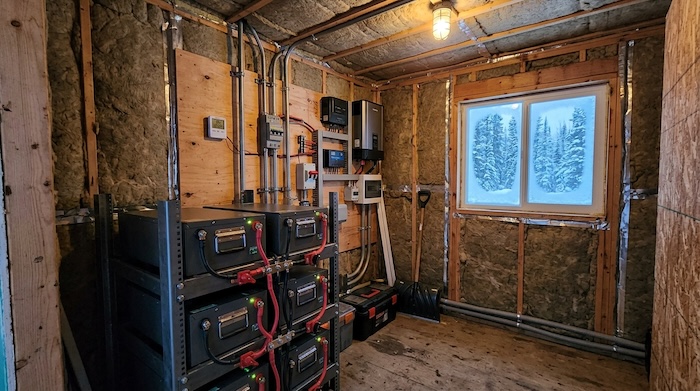
One of the best ways to improve winter battery performance is to provide a suitable location for the battery bank.
Depending on the battery chemistry and installation, this may involve:
-
A temperature-controlled utility room
-
A properly designed insulated battery enclosure
-
Manufacturer-approved battery heating equipment
-
Temperature monitoring
-
Suitable ventilation and electrical protection
Insulation slows heat loss, but it doesn’t generate heat.
An insulated battery box can eventually reach outdoor temperatures if there isn’t enough heat being produced inside.
At our cabin, we’ve used a cooler with Styrofoam insulation to help protect a small marine battery used with our solar setup.
You can read about that arrangement in my Small Cabin Solar Panel Setup for Off-Grid Living.
That experience shows how useful a simple battery enclosure can be, but it shouldn’t be treated as a universal design for larger banks. Battery chemistry, ventilation, heat buildup, electrical protection, and manufacturer requirements all matter.
Flooded lead-acid batteries in particular require appropriate ventilation and should never be placed in an airtight enclosure.
Should You Choose a 12V, 24V, or 48V Battery Bank?
Another decision is battery-bank voltage.
12-Volt Battery Systems
A 12V system is often practical for small cabins, RVs, and modest electrical loads.
It’s a familiar voltage with many compatible appliances and accessories.
However, larger electrical loads require high currents at 12V, which can mean thicker cables and greater wiring losses.
24-Volt Battery Systems
A 24V system can be a useful middle ground for medium-sized cabins.
At the same power level, it carries approximately half the current of a comparable 12V system.
That can make wiring and equipment selection more manageable for larger installations.
48-Volt Battery Systems
Larger off-grid homes often use 48V-class battery systems.
Higher voltage allows substantial power to be delivered at lower current, which can reduce wiring losses and simplify certain aspects of system design.
The right voltage depends on your inverter, charge controller, battery configuration, and electrical loads.
Always use equipment designed for your chosen system voltage.
Why a Bigger Battery Bank Won’t Solve Every Winter Power Problem
Here’s something that’s easy to overlook.
You can have a perfectly sized battery bank and still run out of electricity if your solar panels aren’t producing enough energy to recharge it.
During Canadian winters, solar generation can be reduced by:
-
Shorter daylight hours
-
Low sun angles
-
Heavy cloud cover
-
Snow-covered panels
-
Shading from nearby trees or buildings
Imagine your cabin uses 1kWh daily, but your solar panels only replace 0.4kWh each day.
You’re losing approximately 0.6kWh from your stored energy every day.
A larger battery bank gives you more time, but eventually you’ll still run out of power unless generation increases or you recharge another way.
That’s why battery storage, solar production, and backup charging should always be planned together.
For help calculating your solar needs, read my Off-Grid Solar Power Systems: How Much Do You Need? guide.
Do You Need a Backup Generator for Your Battery Bank?
For cabins used throughout winter, a backup generator can be extremely useful.
Even with a well-designed solar system, there may be periods when cloudy weather and snow prevent your panels from producing enough electricity.
A generator can provide power for battery charging when solar production is insufficient, provided you have compatible charging equipment.
It can also help support high-demand loads without relying entirely on stored battery energy.
At our cabin, we use a dual-fuel generator, giving us the flexibility to operate on gasoline or propane.
If you’re considering backup power, have a look at my Off-Grid Power Systems Guide for help choosing a practical setup.
And don’t forget about fuel storage. My guide to Gas, Propane, and Diesel Generator Fuel Storage explains the advantages and disadvantages of each option.
Never operate a fuel-burning generator indoors or in an enclosed shed. Keep it outdoors, well away from doors, windows, and air intakes because of carbon monoxide hazards.
Common Battery-Sizing Mistakes to Avoid
After looking at the different battery types and calculations, a few mistakes are worth watching for.
1. Sizing Batteries Using Only Summer Conditions
A system that performs well in July may struggle during December and January.
Plan around the season when solar production is lowest and your electrical demands may be highest.
2. Confusing Rated Capacity With Usable Capacity
A 200Ah lead-acid battery doesn’t necessarily provide 200Ah of capacity that you should routinely use.
Always account for recommended depth of discharge.
3. Ignoring Cold-Weather Charging Restrictions
Buying lithium batteries without understanding their charging-temperature limits can lead to serious problems in an unheated cabin.
4. Forgetting About Inverter Losses
Your inverter uses some energy to operate, and converting DC electricity into AC electricity isn’t perfectly efficient.
Include these losses in your calculations.
5. Guessing Appliance Electricity Consumption
Refrigerators, pumps, and other appliances may use more or less electricity than expected.
Whenever possible, measure actual energy consumption rather than relying entirely on estimates.
6. Overlooking Battery Aging
Batteries gradually lose capacity over time.
A system designed with absolutely no reserve may become less reliable as the batteries age.
7. Buying Batteries Before Choosing Compatible Equipment
Your batteries, inverter, charge controller, and charging equipment all need to work together.
Before connecting multiple batteries, confirm that the manufacturer permits the intended series or parallel arrangement.
Battery Safety: A Few Things You Shouldn’t Overlook
Battery banks store a considerable amount of electrical energy.
Even low-voltage systems can deliver enough current to cause dangerous overheating, fires, or severe injuries if improperly installed.
A safe installation should include appropriately sized cables, overcurrent protection, suitable disconnects, and secure battery connections.
Flooded lead-acid batteries also need proper ventilation because charging can release hydrogen gas.
Lithium systems need compatible charging equipment and suitable battery management protection.
Follow manufacturer instructions, applicable electrical codes, and local permitting requirements. For larger installations, use a qualified electrician or solar installer experienced with battery storage systems.
Frequently Asked Questions About Off-Grid Batteries
How many batteries do I need for a small off-grid cabin?
It depends on daily electricity use, battery capacity, and how many days of backup you want.
For example, a cabin using 1kWh daily with two days of backup may need approximately 2.8kWh of nominal LiFePO4 storage under the assumptions used in this guide, before winter adjustments.
What is the best battery for an off-grid cabin?
LiFePO4 batteries are often a strong choice for regularly used cabins because of their long cycle life, high usable capacity, and low maintenance.
AGM or flooded lead-acid batteries may still make sense for certain budgets and occasional-use systems.
Can lithium batteries freeze?
Lithium batteries have specified operating and storage-temperature limits. Many LiFePO4 batteries can discharge below freezing but cannot safely recharge until their cells reach the manufacturer’s minimum charging temperature.
Can you charge lithium batteries below 0°C?
Most conventional LiFePO4 batteries should not be charged below their specified minimum cell temperature.
Some models include internal heaters or other cold-weather charging features.
Always follow the specific battery manufacturer’s instructions.
How long will a 100Ah battery run a refrigerator?
It depends on battery voltage, usable capacity, refrigerator energy consumption, and whether an inverter is required.
A 12.8V 100Ah LiFePO4 battery stores approximately 1.28kWh of nominal energy.
At 80% depth of discharge and 90% inverter efficiency, that provides approximately 0.92kWh of usable AC energy.
If a refrigerator consumes 0.5kWh per day, that would theoretically provide around 1.8 days of operation, before additional losses or reserve allowances.
Is it better to buy more solar panels or more batteries?
That depends on what’s causing your power shortage.
If your batteries are full during the day but empty before morning, you may need more storage.
If your batteries rarely reach a full charge, you may need more solar generation or another charging source.
Often, a balanced combination of panels, batteries, and generator backup works better than oversizing one component.
How long do off-grid solar batteries last?
Lead-acid batteries may last several years, depending on maintenance and cycling conditions.
Quality LiFePO4 batteries can potentially last ten years or longer under suitable conditions.
Check manufacturer cycle-life ratings and warranty terms rather than relying on a general lifespan estimate.
Final Thoughts: Build a Battery Bank for the Winter You Actually Get
Choosing off-grid batteries isn’t just about finding the lowest price or buying the newest technology.
It’s about understanding how much electricity your cabin needs and making sure your battery bank can supply that power when conditions aren’t ideal.
For a small weekend cabin, a modest battery bank may be all you need.
For a year-round off-grid home, you’ll want to pay much closer attention to winter solar production, battery temperature, charging equipment, and backup power.
Lithium iron phosphate batteries offer some impressive advantages, but they’re not automatically the right choice for every situation.
Lead-acid batteries still have their place, especially in simpler systems where initial cost matters.
The most important thing is to do the calculations before spending your money.
A battery bank that works beautifully in July isn’t much help if it leaves you without electricity during a January snowstorm.
Plan for your actual electricity use, choose batteries that suit your climate, and make sure you have a reliable way to recharge them.
That’s how you build an off-grid power system you can depend on.
Disclosure: This article contains affiliate shopping links. If you purchase through qualifying Amazon links after they are replaced with my Amazon Associates links, I may earn a small commission at no additional cost to you. The information provided is for educational purposes. Always follow manufacturer specifications and applicable electrical safety requirements.
© 2026, Teresa. All rights reserved.