Time to look at off-grid lighting as our small cabin gets closer to becoming a guest room. While we’ve relied on a generator during renovations, that’s not a permanent or practical solution for everyday cabin life.
When you live off grid, lighting quickly becomes more than a convenience — it’s essential. Even with well-positioned windows that provide natural daylight, evenings, overcast days, and long winters make reliable lighting a priority.
When exploring off-grid lighting ideas, there are many options to choose from. It’s natural to look for the most efficient solutions, but that doesn’t mean you have to sacrifice quality. With the variety of lighting options available today, it’s possible to find systems that are both effective and affordable.
Living in an area with long winters, like we do, also means considering how many hours of darkness you’ll be dealing with and planning lighting accordingly. Having multiple lighting options available — especially for bad weather or unexpected power outages — is always a good idea.
The good news is:
- Off-grid lighting alternatives are easy to find
- There are several reliable options to choose from
- Many lighting solutions require little to no money
As we decide on the best lighting setup for our off-grid cabin, here are the most common lighting options we’ve used or researched for off-grid living.
Table of Contents
Off-Grid Lighting Options for Cabins
Candle Lighting for Off-Grid Living
Candles are a simple and inexpensive way to light an area. I make my own candles and use them in a homemade hurricane lamp. The lamp was made by placing sand in the bottom of a flower vase and setting a glass votive holder into the sand.
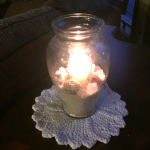
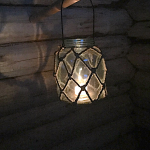
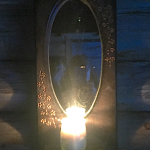 With candlelight, brightness depends on how many candles you’re using and what’s behind them to reflect the light. When I took the photos, I was using tea lights. On a later visit, I switched to votive candles, and the light was noticeably brighter.
This is something I continue to experiment with. I love making candles, and there’s something about candlelight that creates a warm, comforting atmosphere — although it would be difficult to sit and read a book using candlelight alone.
For off-grid living, it’s important to consider the type of candle, placement, and safety. Because candles involve an open flame, I never light one unless it’s inside a hurricane lamp.
Oil Lamps for Cabin Lighting
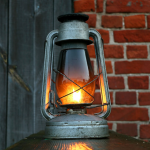
Oil lamps are another traditional way to light a cabin. They work by filling the base of the lamp with oil and lighting a wick that draws the oil upward, producing a steady flame.
Oil lamps were widely used to light homes before electricity became common. In the 1800s, paraffin oil was preferred because it was inexpensive and smokeless. Earlier fuels included kerosene, coal oil, animal fats, and even olive oil.
While researching oil lamps, I came across a simple design using a mason jar and olive oil. Olive oil burns cleanly, produces no noticeable odor or smoke, and is readily available — especially for us, since I’m a soap maker and keep plenty of olive oil in cold storage. Nathan and I plan to make one of these oil lamps to try in the cabin.
As with candles, oil lamps should be used with care, as they also present a fire risk.
Battery-Powered Lighting Options
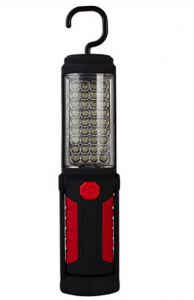
Battery-powered lighting is often a necessary part of off-grid living because it provides a reliable backup when other options aren’t available.
Flashlights are a great portable lighting solution, especially for short-term use or emergencies. Today, there are also hand-crank and solar flashlights that don’t rely on disposable batteries.
LED flashlights are by far the most efficient option and are especially good for homes with children. Unlike candles or oil lamps, they don’t pose a fire risk and don’t produce fumes.
We keep several battery-operated LED flashlights and lanterns in the cabin. I also make sure we have a good supply of batteries on hand — experience has taught me that it’s easy to accidentally leave a light on longer than intended.
For off-grid situations, 12-volt batteries and lighting systems are widely available at automotive and hardware stores. Keep in mind that 12-volt lights are not designed to run on standard 110-volt outlets. While we haven’t used this setup yet, solar power is likely the direction we’ll go in the future.
I make sure we have a good stock of batteries, because you never know. I fell asleep one night reading with one of the led flashlights hanging on the wall above me and by the time I woke up it was light and I didn’t notice it was still on. Needless to say the next time I wanted to use it the battery was dead.
Solar Lighting for Off-Grid Cabins
When choosing bulbs for a solar system, it’s important to remember that LED bulbs typically draw around 6 watts, while traditional incandescent bulbs can pull 60–75 watts. LEDs provide far more light for far less energy.
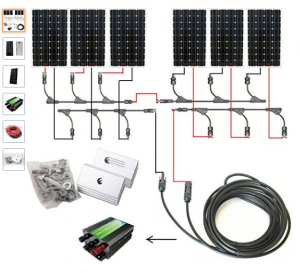
Many off-grid homes are switching to solar power and installing small solar lighting systems that include panels, batteries, and an inverter. These kits are available at home supply stores and online, with prices ranging from around $100 to several thousand dollars depending on size and capacity.
While professional installation is an option, it adds significant cost. When it’s time to install solar power in our cabin, we plan to take a course and do the work ourselves — with the goal of eventually being able to help others do the same.
Solar lights, solar flashlights, and other solar-powered devices can provide several hours of lighting on a single charge, especially when paired with efficient LED bulbs.
That said, solar lighting does have its limitations. In areas with limited sunlight — particularly during winter — solar systems may not fully recharge. For this reason, it’s wise to combine solar lighting with other options.
Standalone solar lights also need to be placed outside regularly to recharge, which can become inconvenient or easy to forget.
Lighting Is Easy to Plan for Off-Grid Living
Balancing natural daylight with a mix of lighting options can make off-grid cabin life far more comfortable and enjoyable. Whether you choose rechargeable LEDs, solar lighting, oil lamps, candles, battery-powered lights, or a full solar system, the key is finding the right combination for your needs.
There are many styles and designs available for off-grid cabin lighting, and with thoughtful planning, creating a practical and welcoming lighting setup is very achievable.
We’ll continue trying and testing different lighting options as we renovate and rebuild the main cabin.
Solar Lighting We Actually Use in Our Cabin
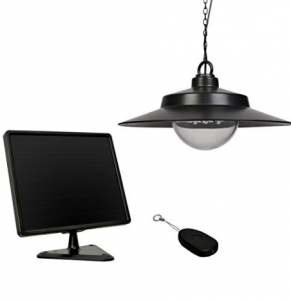
Nature Power 21030 Hanging Solar Powered LED Shed Light
This was the first solar light we tested, and we absolutely love it.
I purchased this light from Amazon and expected it to provide only minimal lighting — but it exceeded our expectations. Installation was quick and easy, taking only a few minutes.
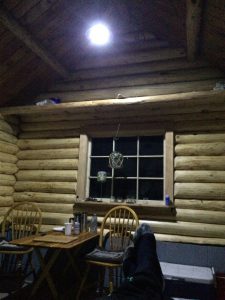
The solar panel mounts outside the cabin, with the cord run through a small opening to the light fixture inside. After securing everything with a couple of screws, it was ready to charge.
We let the light charge for a full day and were pleasantly surprised when we turned it on the following evening. Hung above the table, it provides enough light to comfortably read by.
The adjustable chain makes it easy to set the light at the perfect height. It offers both low and high settings, controlled by a handy keychain remote.
Although it’s marketed as a shed light, it’s far too nice to be limited to a shed. The fixture feels solid and well-made, with a heavy glass lens rather than cheap plastic.
At around $60, the cost is very reasonable. I couldn’t be happier with this light and plan to order one or two more for our larger cabin. I would definitely recommend it.
You can see how well it lights up the cabin
Solar String Lights for Ambient Lighting
Another option we like is solar-powered string lights. These are a great choice for adding soft, ambient lighting around outdoor seating areas or covered porches.
They’re affordable, easy to install, and create a warm, welcoming atmosphere without drawing much power — perfect for off-grid use.

Disclosure:
Content on this site is for informational purposes only and reflects personal experience and research. Off-grid living laws and conditions vary by location, so readers should always verify local regulations before making decisions. Some links may be affiliate links, which help support this site at no additional cost to you.
Updated Feb 2026
© 2017 – 2026, Teresa. All rights reserved.
Hey Jill,
Thanks for sharing this awesome post! I love all the lighting ideas you shared. I think be best for those who live off the grid would be solar systems as you don’t have to rely as much on additional supplies of batteries or oil. I also have some of those solar system lights at home, they come in so handy when you have a sudden power cut. Which solar lights lamps or brands do you recommend?
Thanks for sharing!
Cheers,
Anh
Your welcome Anh. I agree the solar system is probably the best. It will be awhile before we can instal that, in the mean time I am testing out the other methods. When I have tried the solar lights I will update this page with my recommendations.
This is a great post. I sometimes wonder about the challenges and how difficult it must be to live off the grid. But with articles such as this one, it should make life much easier for everyone.
I guess solar panels are an excellent long term choice. But I wonder if the cost of maintaining such systems are high. This is something that one should consider before making a purchase. What do you think?
Great article!
I really do like the idea of solar panels as a long term choice, I would think the most expensive maintenance would be battery replacements. We haven’t tried this yet, but will be sure to let everyone know how it goes when we do.
Hi Jill!,
A big part of me is so jealous of your life style. I believe this should be our natural state of being…. But… there is always a but in front of a difficult decision.
I am a lighting designer and i can tell you that you have covered every significant type of off grid lighting.
I agree with the rest of the comments that solar lighting is a good solutions but if there is no sun for a couple of days then you have a problem.
I think that a basic type of lighting should be available in every house. I have candles in my house and it is in the center of a city. Because you never know…
You are right, though, oil lamps and candles are not for fun. We have to use them with extra extra caution.
Thanks for commenting on my post, it’s good to hear from a lighting designer. Where we live we have very few days without sun. Beautiful blue skies most of the winter, so that is good. I do like to have other options though for those days of grey skies and rain or snow.
Thanks for posting such great information about lighting a cabin off the grid.
I found it to be very interesting, even though I am not the kind of person who would like to be off the grid.
I kind of like a combination of the oil lamps and an LED battery powered light….I think that the oil lamp has more of an “off the grid feel” and the LED light could actually provide good light!
What is your lighting preference?
Right now I have to agree. The oil lamp is nice to have and the LED is nice for reading etc., but hopefully in the future I will have some kind of solar lighting. That would be my choice…with the others for backup of course
I do like the idea of solar powered lighting, okay you have initial expense but over the long term you can light the home for peanuts.
We have gone all the way through our home and installed LED bulbs, what a difference this has made to the electric bill therefore I can understand the combination of solar panels with LED lights makes so much sense regarding power consumption.
Also LED lights have come along way in recent times, what once was a dull start to warm up and remain dim now turns on with immediate brightness and stays that way alike traditional bulbs plus the bulb prices have started to become more reasonable.
How did you get on installing the solar panels, did you attend an installation course?
Simon.
Hi Simon, I agree with the LED lights, we built a house 5 years ago and I installed LED lights throughout. To date I have only had one burn out so they last a long time.
As for the off grid cabin, unfortunately forest fires ravaged our area last summer and for most of it we were unable to access the property so all reno’s came to a halt. Hopefully in the next year we will get some solar panels installed.
We have been looking at taking or attending an installation course.
if a family had to live off grid as a no choice , survival thing ,does anyone know how much kerosene a person would have to have for a year ,just to use for oil lamps to light up a 3 bedroom ,1 bath house?
Hi Lauyana,
Kerosene is pretty expensive. I would be more inclined to use Propane. A large propane tank can last quite awhile and with that you could have a gas stove and dryer.
For lights I like to use solar. We have just a couple solar panels for lights in the cabin and they work very well and really cost nothing one they are set up.
Have a read here on installing solar panels
Solar Panels for Cabin