This post documents the very beginning of our off-grid cabin journey — how we found the property, what we walked into, and why we decided to take it on. This project became the foundation for everything we now share about off-grid living.
If you’re new here, you can explore the bigger picture in our guide to [Off-Grid Living], but this is where our cabin story truly begins.
Many of the skills we relied on came from years of learning through trusted off-grid books and hands-on resources.
How We Found the Property
In early 2016, we went out looking for property. At the time, we did not intend to live off-grid. We were simply hoping to find a place of our own — somewhere quiet, with space to work and room to grow.
Then we found this 10-acre piece of land.
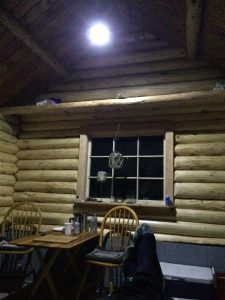
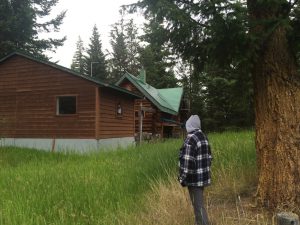
The property included an old homestead with a root cellar, an overgrown garden that cried out to be reclaimed, and two cabins tucked into the trees — a main cabin and a smaller log cabin nearby. It was clear the land had a history, and although it needed work, it immediately felt like a place we could make our own.
Two Cabins, Two Very Different Starting Points
When we purchased the property, there were two cabins, and each came with its own challenges.
The main cabin was structurally solid, but it had a poorly built addition and hadn’t been lived in for quite some time. It was obvious it would be a larger, long-term project — one we weren’t ready to tackle right away.
The small cabin, however, was where we needed to start.
That little cabin had been neglected for years. A tree had fallen onto the roof, packrats had completely taken over, and the inside had become a dumping ground for everything imaginable — old heaters, ducting, garden tools, plant pots, insulation, and miscellaneous supplies.
Before we could work on the main cabin, the land, or anything else, we needed a dry, safe place to warm up, store tools, and base ourselves from. With winter access limited to snowmobiling and the roads not maintained year-round, the small cabin became the obvious first priority.
Why This Project Made Sense for Us
Taking on a project like this wasn’t entirely new territory.
Scott is a carpenter and has rebuilt, renovated, and built cabins in remote locations for years — including fly-in fishing camps where supplies had to be brought in by float plane, and winter builds where materials were hauled in by snowmobile once lakes froze.
For a long time, he had talked about wanting a cabin of our own in the woods to work on.
This place was exactly that.
From the beginning, our goal was to rebuild and restore using recycled and reclaimed materials whenever possible, buying only what was absolutely necessary. This wasn’t about rushing or making everything perfect — it was about bringing the property back to life, one step at a time.
The First Phase: Cleaning and Reclaiming the Small Cabin
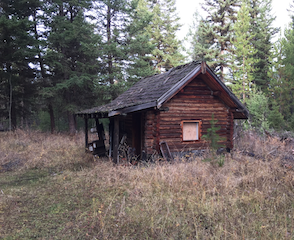
The early days of the project focused entirely on the small cabin.
Before we could even think about repairs, we had to clean up the area around it. Dead trees were removed from the roadway and near the cabin — both to improve access and to prevent further damage.
Inside, the work was less glamorous.
It was my job to weed-eat around the cabin (my favorite chore… not), while Nathan tackled cleaning out the interior. There was so much piled inside that we weren’t even sure what we were going to find.
What we uncovered was a mix of usable and unusable items:
- An old wood stove
- An electric furnace and ducting
- Electric heaters
- Insulation
- Plant pots and garden tools
Unfortunately, we also found extensive packrat damage. One of the more unpleasant discoveries was a packrat nest built inside the old wood stove — disgusting, to say the least.
Anything that couldn’t be salvaged was loaded into the truck and hauled to the dump. Anything usable was set aside for later projects.
There was also a manger attached to the back of the small cabin. We later learned the previous owners had kept a cow on the property and fed it there. Since cattle weren’t in our plans, the manger came down as well.
By the end of this phase, the inside of the small cabin was gutted, cleaned out, and finally usable — rough, but functional.
Making the Small Cabin Winter-Ready
Because the roads aren’t maintained year-round, winter access to the property means snowmobiling in. If we were going to spend time working on the land during colder months, the small cabin needed to be safe, dry, and warm.
Some of the major early tasks included:
- Removing and replacing the damaged roof
- Critter-proofing the cabin to prevent further infestations
- Pulling up the old flooring
When we removed the floor, we discovered a solid concrete base lined with plastic underneath — a lucky surprise that saved us a lot of work.
Inside the cabin, we found both a propane furnace and a wood stove that could potentially be reused elsewhere. The wood stove, however, was far too large for the small cabin, so we set it aside for a future project.
For now, we installed a small tent stove, which would keep the cabin cozy and usable when snowmobiling in during winter.
Slowly, the small cabin began to feel like a real base camp — a place we could warm up, store tools, and continue work on the rest of the property.
Setbacks, Delays, and Reality Checks
Like most long-term projects, progress didn’t always move as quickly as we hoped.
There were hiccups along the way — including a wildfire that forced us to evacuate the property for an entire summer. Work and everyday life also had a way of slowing things down.
Still, each time we returned, we picked up where we left off.
Off-grid projects have a way of teaching patience whether you want to learn it or not.
Looking Back: A 2019 Reflection
Looking back on this project a few years later, it’s hard to believe how far that little cabin has come.
What once felt overwhelming slowly turned into something usable and familiar. The small cabin had been cleaned out, the area around it cleared, trees taken down, a new roof installed, and a wood stove put in place so we could stay warm when snowmobiling in during winter months.
It didn’t happen as quickly as we once imagined, but progress is progress — and every step taught us something new.
Clearing the Land and Starting Fresh
One of the first visible changes to the property was removing several abandoned vehicles left behind by previous owners — including one parked directly in front of the main cabin.
Clearing those vehicles helped us reclaim the land and mentally mark a fresh start.
That experience deserves its own story, which you can read here:
Goodbye Junk Cars! Free Vehicle Removal on Our Off-Grid Property
Where the Project Goes From Here
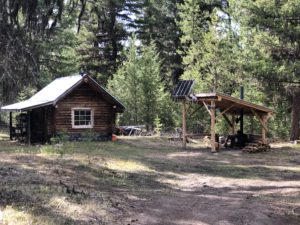
This post marks the true beginning of our off-grid cabin project.
The small cabin became our starting point — our base camp — and made it possible to continue work on the rest of the property, including the main cabin.
In future posts, I’ll share more detailed looks at specific phases of the work, including:
- Cleaning and restoring the small cabin
- Roof removal and replacement
- Winter access by snowmobile
- Long-term plans for the main cabin
Along the way, I’ll also share the lessons we’ve learned, mistakes we’ve made, and tips that might help others considering a similar path.
This cabin project didn’t just give us a place in the woods — it became the heart of everything we now share about off-grid living.
And this is just the beginning.
Important Note:
This information is for educational purposes only.
This post may contain affiliate links. If you make a purchase through these links, I may earn a small commission at no extra cost to you.
Updated Feb 2026
© 2026, Teresa. All rights reserved.