
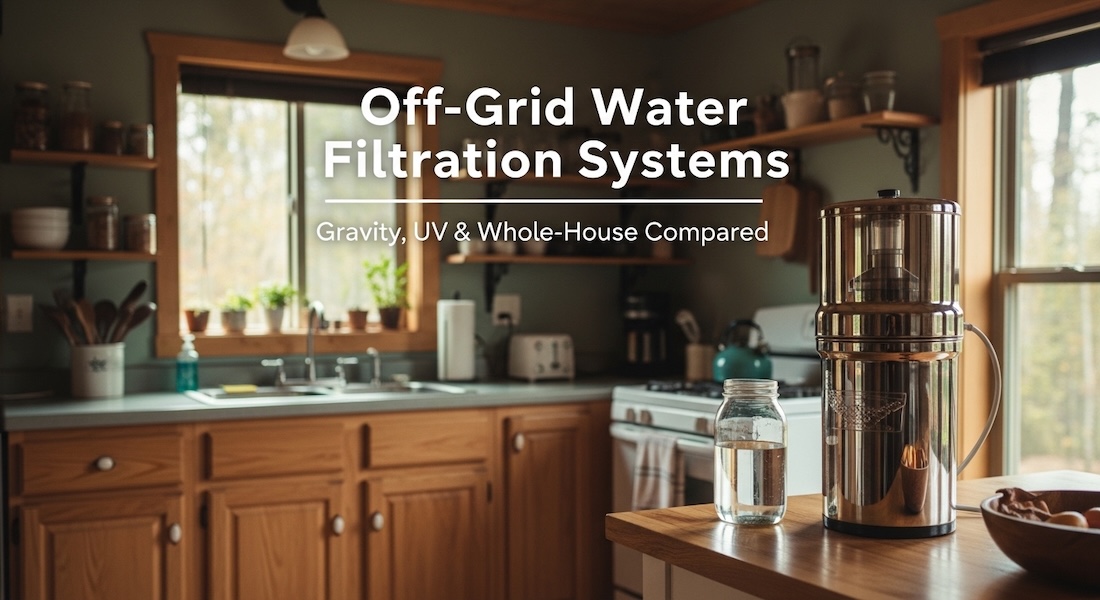
Living off-grid means I’m responsible for making sure my water is safe. There’s no city utility checking quality for me. It’s up to me to filter sediment, prevent contamination, and stay on top of maintenance so I don’t end up with a preventable water emergency.
That’s why choosing the right off-grid water filtration system matters.
Filtration and purification are not the same thing. One handles visible debris and some bacteria. The other neutralizes microscopic threats you can’t see — but definitely don’t want to drink.
A properly designed off-grid water filtration system protects your health, your plumbing, and your independence.
I get asked all the time which system is best for an off-grid cabin or homestead. The honest answer? It depends on your water source, your setup, and how much redundancy you want built into your system.
If you’re building a rainwater collection system, start with my complete guide to safe rainwater collection, storage, and filtration. That article walks through barrel setup, diverters, and safe storage practices before you even get to the filtration stage.
-
- Filtration vs. Purification: What’s the Difference?
- Types of Off-Grid Water Filtration Systems
- Quick Comparison: Which System Is Best?
- Recommended Off-Grid Water Filtration Systems
- What Off-Grid Water System Do You Actually Need?
- When Should You Test Your Water?
- Common Off-Grid Water Filtration Mistakes
- My Recommended Simple Starter Setup
- Is Filtered Rainwater Safe to Drink?
- Final Thoughts
Filtration vs. Purification: What’s the Difference?
This is where many off-grid water problems begin.
Clear water does not automatically mean safe water.
Filtration Removes:
-
-
- Sand
- Sediment
- Debris
- Some bacteria (depending on micron rating)
-
Filtration improves clarity and protects plumbing. It’s an essential first stage in any off-grid water filtration system.
Purification Neutralizes:
-
-
- Bacteria
- Viruses
- Protozoa
- Harmful pathogens
-
Purification goes beyond clarity. It targets microorganisms that can make you sick even when water looks perfectly clean.
I treat filtration and purification as stages — not substitutes for each other.
Types of Off-Grid Water Filtration Systems
1️⃣ Sediment Filters (First-Stage Protection)
Sediment filters are my first line of defense. They remove grit, sand, and debris before water reaches more expensive components.
Removes: dirt, sand, roof grit
Protects: UV lights, carbon filters, pumps, plumbing
Best for: rainwater systems, wells, gravity setups
These filters improve clarity but do not make water safe to drink on their own.
They’re inexpensive, easy to install, and dramatically extend the life of your overall off-grid water filtration system.
2️⃣ Gravity Water Filters (Most Popular Off-Grid Option)
Gravity-fed systems are common in off-grid kitchens because they require no electricity. You pour water into the top chamber, and it slowly filters through ceramic or carbon elements.
Pros:
-
-
- No power required
- Portable
- Simple to maintain
-
Cons:
-
-
- Slower filtration
- Not all systems remove viruses
-
Best for: drinking water in cabins, small households, emergency backup
These are reliable and practical. For many off-grid beginners, a gravity filter is the easiest way to create safe drinking water.
However, if your water source has viral contamination risk (surface water especially), you’ll need an additional purification layer.
3️⃣ Ceramic Filters
Ceramic filters physically block bacteria based on pore size.
A 0.2 micron ceramic filter will block most bacteria like E. coli or Salmonella. Viruses, however, are smaller and can pass through.
Advantages:
-
-
- Reusable (can be scrubbed clean)
- Long lifespan
- Easy to integrate into gravity systems
-
Limitations:
-
-
- Does not remove viruses
- Must be replaced if cracked
-
Ceramic works extremely well as part of a layered off-grid water filtration system — but it should not be your only protection if viral contamination is possible.
4️⃣ UV Water Purifiers (True Purification Layer)
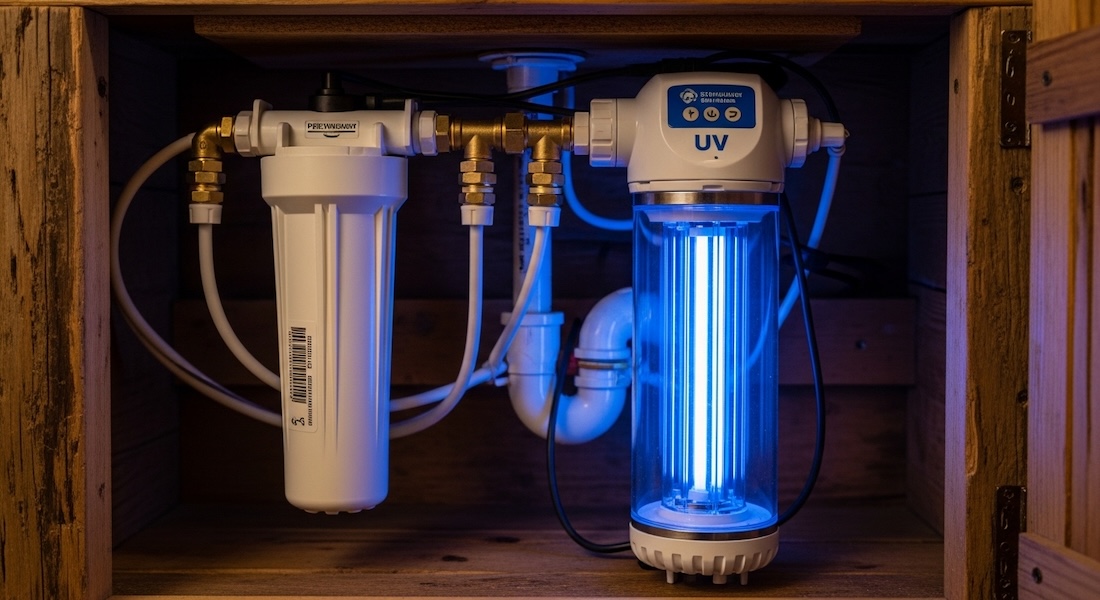
UV purifiers use ultraviolet light to neutralize microorganisms as water flows past the bulb.
Kills:
-
-
- Bacteria
- Viruses
- Protozoa
-
Pros:
-
-
- On-demand treatment
- Extremely effective
- Ideal for full-time drinking water
-
Cons:
-
-
- Requires power
- Needs clear water before treatment
-
UV does not remove sediment or improve taste. It only neutralizes living organisms.
That’s why sediment filtration must come first.
For full-time off-grid homes relying on rainwater or untreated wells, UV purification adds critical protection. This is the same technology many municipal systems use — just scaled down for home use.
5️⃣ Whole-House Off-Grid Water Filtration Systems
Whole-house systems treat every tap in your home. They typically combine:
-
-
- Sediment stage
- Carbon stage
- UV purification stage
-
These are ideal for:
-
-
- Full-time off-grid homes
- Multi-bathroom setups
- Families or small farms
-
They require more installation and cost more upfront, but maintenance is typically once or twice per year.
For weekend cabins, this may be overkill. For long-term off-grid living, it’s often worth it.
Quick Comparison: Which Off-Grid Water Filtration System Is Best?
| System | Power Required | Removes Viruses | Best For |
|---|---|---|---|
| Gravity Filter | No | Usually No | Small cabins |
| UV Purifier | Yes | Yes | Full-time homes |
| Sediment Filter | No | No | Pre-filtration |
| Whole-House | Often Yes | Yes (if UV) | Large households |
There is no single “best” system. The best off-grid water filtration system is one that matches your water source and risk level.
Recommended Off-Grid Water Filtration Systems (Reliable & Beginner-Friendly)
Choosing the right off-grid water filtration system can feel overwhelming. These are solid, widely used options that match the systems discussed above.
Gravity Water Filter (No Power Required)
Best for: Cabins, small households, emergency backup drinking water
A stainless steel gravity-fed water filter with ceramic or carbon elements is one of the simplest and most dependable ways to filter drinking water off-grid. It requires no electricity and works even during power outages.
👉 See recommended gravity water filter options here.
Why I like this type:
-
-
- Reliable
- Portable
- Easy to maintain
- Great first step for beginners
-
Not ideal if:
-
-
- You need to filter large volumes quickly
- You want whole-house treatment
-
For most small cabins, this is the simplest and most practical starting point.
UV Water Purifier (True Purification for Daily Use)
Best for: Full-time off-grid homes using rainwater or untreated wells
A UV water purifier installs inline and neutralizes bacteria, viruses, and protozoa as water flows through the chamber.
👉 View recommended UV water purification systems here.
Why I recommend UV for serious setups:
-
-
- On-demand treatment
- Extremely effective against pathogens
- Great for families
-
Important:
UV requires clear water first. Always install a sediment pre-filter ahead of it.
Sediment Pre-Filter (Essential First Layer)
Best for: Protecting pumps, plumbing, and expensive filters
A simple sediment filter removes grit, sand, and roof debris before water reaches your drinking system.
👉 See inline and cartridge sediment filters here.
This is one of the most important (and affordable) components of any off-grid water filtration system.
Whole-House Filtration System
Best for: Full-time homes with multiple taps and bathrooms
Whole-house systems combine sediment, carbon, and often UV purification into one setup that treats all household water.
👉 Explore whole-house filtration systems here.
These systems are ideal for long-term off-grid living but may be unnecessary for weekend cabins.
Note: Always verify micron ratings and system capacity before purchasing. Your water source and household size determine what system will work best.
What Off-Grid Water System Do You Actually Need?
| Water Source | Minimum Needed | Ideal Setup |
|---|---|---|
| Rain Barrel | Sediment + Gravity | Sediment + Carbon + UV |
| Well Water | Sediment | Sediment + UV |
| Surface Water (Creek/Lake) | Gravity | Gravity + UV |
| Emergency Storage | Gravity | Gravity + UV |
Water security is about layers. If one system fails, another still protects you.
When Should You Test Your Water?
Even the best off-grid water filtration system should be supported by occasional testing.
Test your water:
-
-
- After heavy storms
- After roof repairs
- If taste or smell changes
- If wildlife nests near gutters
- If anyone experiences stomach illness
-
Annual testing is wise if you rely on well or rainwater as your primary source.
Common Off-Grid Water Filtration Mistakes
-
-
- Assuming filtration equals safe drinking water
- Skipping sediment pre-filtration before UV
- Ignoring filter replacement schedules
- Storing filtered water in clear containers
- Choosing filters without checking micron ratings
-
Maintenance prevents emergencies.
My Recommended Simple Starter Setup
If I were starting from scratch today, here’s what I’d build:
-
-
- Downspout diverter for clean rainwater collection
- Sediment pre-filter
- Gravity-fed ceramic/carbon drinking filter
- UV purifier if relying on rainwater or surface water
-
This layered approach mimics municipal water treatment — just scaled down for off-grid living.
Redundancy builds confidence. If one layer fails, another protects you.
Is Filtered Rainwater Safe to Drink?
It depends on your system.
Sediment or ceramic filtration alone may improve clarity and taste, but without purification, microorganisms can remain.
If rainwater will be used for cooking or drinking, adding UV or another purification method is strongly recommended.
Always follow local regulations if plumbing rainwater indoors.
Final Thoughts: Building Real Water Security Off-Grid
Water security off-grid isn’t about buying the most expensive system.
It’s about:
-
-
- Understanding your source
- Layering protection
- Maintaining your equipment
- Testing when needed
-
With the right off-grid water filtration system and regular maintenance, you can create a safe, resilient water setup that supports true independence.
Disclosure: This site may contain affiliate links. Content is for informational purposes only and reflects personal experience. Always do your own research before making decisions.
© 2026, Teresa. All rights reserved.